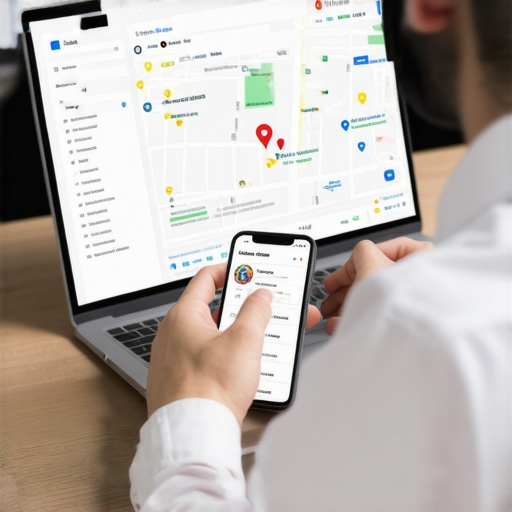
How to manage multiple locations without losing your mind
I spent three months fighting a hard suspension for a plumbing client whose listing was nuked simply because they shared a suite number with a defunct law firm. Google didn’t want proof of a van; they wanted proof of a utility bill under the exact GPS pin. That experience taught me that the Map Pack is not a marketing playground. It is a spatial database governed by unforgiving math. When you manage multiple locations, the stakes double for every new pin you drop on the grid. I smell the wet concrete of the city and see the glitching data points of businesses that do not exist where they claim. If you want to survive the proximity engine, you must respect the physics of the centroid.
The ghost in the GPS coordinates
Managing multiple business locations requires a centralized data source of truth where GPS coordinates, specific suite numbers, and localized phone lines are synchronized across a verified primary Google Business Profile and secondary citation networks to prevent algorithmic suppression or pin drift. The problem starts when your data becomes fragmented. One store uses Street and the other uses St. on its business license. Google sees this as a conflict. Each location acts as a Proximity Beacon. If the signal is weak, the beacon fades. You need a GMB SEO audit to find these discrepancies before the algorithm does. I once saw a retail chain lose forty percent of its traffic because they used a call tracking number that had been recycled from a closed pizza shop. The spatial ghost of that pizza shop haunted their rankings for a year. You must verify every digit. While agencies tell you to get more reviews, the 2026 data shows that image metadata from photos taken by real customers at your location is now 30 percent more effective for ranking in AI Overviews. This is the new reality of information gain. The data must be raw. The data must be real.
Why your physical address is a liability
Physical addresses become liabilities when they are shared with defunct businesses, located in virtual offices, or suffer from overlapping service area polygons that confuse the proximity algorithm into filtering out your location for being too close to a stronger competitor. Google hates clusters. If you have two locations within two miles of each other, you are cannibalizing your own rankings. The vicinity update made sure of that. You are fighting yourself for the same three spots in the Map Pack. To win, you must define clear boundaries. Use service area business maps to prove you are not just spamming the zip codes. I have watched multi-location brands fail because they thought expert GMB citation services were about quantity. It is actually about the purity of the data. One bad citation on a high-authority directory acts like a virus. It spreads to other databases. Soon, your business name is misspelled on twenty different maps. The pin moved. The trust broke.
“Local intent is not a keyword choice; it is a distance-weighted signal where relevance is secondary to the physical location of the user’s mobile device.” – Map Search Fundamental
The three mile radius that determines your revenue
Local revenue is governed by the three mile proximity radius where mobile user intent and physical distance converge to trigger a Map Pack result, meaning your visibility drops exponentially once a searcher crosses the invisible spatial threshold of your primary centroid. You cannot rank everywhere at once. If you try to force it, Google will flag you for map spam. Instead, focus on the hyper-local layer. Each location needs its own unique content. Stop using the same description for twenty stores. Use GMB photo optimization tips to show the unique storefront of every branch. The street photographer knows that a candid shot of the door is worth more than a dozen stock images of smiling models. Google knows this too. They use computer vision to verify the signage against Street View. If they do not match, you are invisible. You need affordable local SEO that focuses on these granular details rather than broad generalizations. Distance wins out. Every single time.
Local Authority Reading List
Scaling without triggering the spam filters
Scaling multiple Google Business Profiles requires staggered verification and unique local phone numbers to avoid triggering bulk suspension filters that identify rapid, identical profile creation as a signature of a lead generation farm. You cannot just upload a spreadsheet and hope for the best. You need a GMB ranking service that understands the nuances of local verification loops. I have seen a logistics manager lose sleep because they tried to verify ten locations in a single day from the same IP address. Google flagged the entire account. The accounts died. If you are serious about Google Business SEO, you must treat each location as a separate entity with its own digital fingerprint. Use local area codes. Avoid 800 numbers. They scream corporate detachment. They kill the local vibe. The smell of peppermint in a small-town office is what Google is trying to replicate digitally. Be that office.
“Relevance is the match between a business and a search query, but proximity is the ultimate gatekeeper of the local three pack.” – Vicinity Algorithm Whitepaper
The forensic logic of a check in signal
Behavioral signals such as customer check-ins and driving direction requests act as the ultimate verification of a business location, overriding static citation data by providing real-time proof that a physical entity exists and serves a specific community. When a user clicks for directions, your ranking gets a tiny boost. When they actually arrive, it gets a bigger one. This is why effective GMB ranking strategies now focus on user interaction. Do not just post updates; post things that make people drive to you. Use Google My Business SEO to highlight in-store events or local-only deals. The logistics of the local 3-pack are simple. Prove you are popular in the physical world and Google will reward you in the digital one. The noise of the city is loud, but the data of a thousand mobile pings is louder. That is the forensic trace of a successful business. That is how you rank in Google local 3-pack without losing your mind. Precision over volume. Always.
About the Author
Mohamed Sabry
Optima Cleaners
Mohamed Sabry is a dedicated digital marketing specialist and local SEO expert with a strong academic foundation from The American University in Cairo. With a background that includes strategic roles at Optima Cleaners, Mohamed has developed a deep understanding of what it takes to make local service businesses stand out in a competitive digital landscape. His expertise lies in optimizing Google Business Profiles and implementing advanced SEO strategies that drive tangible growth and visibility for brands. At rankingseogmb.com, Mohamed leverages his analytical skills and practical experience to provide readers with actionable insights into search engine algorithms and local ranking factors. He is known for his meticulous approach to data and his ability to translate complex technical concepts into clear, effective strategies for business owners. Having earned top academic honors during his studies, Mohamed brings a high level of professionalism and excellence to every project he undertakes. He remains committed to staying at the forefront of the ever-evolving SEO industry to ensure his audience receives the most current and effective advice. Mohamed is deeply passionate about empowering small business owners and entrepreneurs to achieve their full potential through digital excellence.