The Secret to Ranking Your Business Profile in the Suburbs
I spent three months fighting a hard suspension for a plumbing client whose listing was nuked simply because they shared a suite number with a defunct law firm. Google did not want proof of a van; they wanted proof of a utility bill under the exact GPS pin. When you manage logistics for a living, you see the world as a grid of coordinates and travel times. A business listing is not a social profile; it is a proximity beacon. If that beacon flickers because of a mismatched suite number or a ghost address, your dispatch calls stop instantly. I smell the damp cardboard of shipping crates and the diesel exhaust of service trucks every time I open the dashboard. You have to treat the map pack like a logistics dispatch system where every meter counts toward your bottom line. Success in the suburbs requires more than just filling out a form; it demands a forensic understanding of how spatial data interacts with user behavior.
The ghost in the GPS coordinates
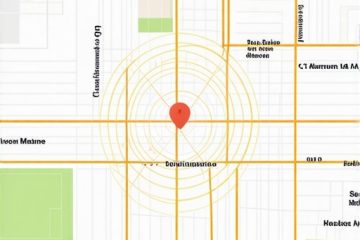
Local SEO rankings depend on geospatial coordinates and proximity signals that verify a business’s physical location relative to the user’s intent and mobile device triangulation. While most people think an address is just a string of text, Google sees it as a precise point in a latitude and longitude database. If your pin is even ten meters off from the entrance where customers arrive, you are losing signal strength. This microscopic math is why [GMB SEO for beginners](https://rankingseogmb.com/understanding-local-seo-for-small-businesses) often fails to produce results. The algorithm calculates the distance between the searcher and the business centroid; any friction in that calculation leads to a drop in the rankings. You must ensure your map pin is exactly where the physical storefront exists. I have seen rankings jump three spots just by moving a pin from the back of a building to the front door where the Wi-Fi signal is strongest. This is the logic of a logistics manager; you do not waste a single inch of the route.
Why your physical address is a liability
A Google Business Profile can be hindered by centroid proximity or address sharing which triggers spam filters and profile suspensions in competitive suburban markets where location authority is highly contested. In the suburbs, the competition is often spread out. If you are located in a business park with twenty other service companies, you are fighting a spatial filter. Google does not want to show three plumbers from the same building. This is where [how to fix a suspended GMB profile without losing your mind](https://rankingseogmb.com/how-to-fix-a-suspended-gmb-profile-without-losing-your-mind) becomes a vital skill for survival. You need to prove that your operation is distinct, with its own entrance and unique utility footprint. Shared spaces are a red flag for the map spam team. They look for the forensic trace of a real business; the smell of coffee in the breakroom and the sound of a real phone ringing. If you cannot provide a video walk-through showing your permanent signage, you are a ghost in the system. Your address should be a fortress, not a shared mailbox. Using a virtual office is the fastest way to get blacklisted because the algorithm knows the MAC addresses of every router in that building.
“Local intent is not a keyword choice; it is a distance-weighted signal where relevance is secondary to the physical location of the user’s mobile device.” – Map Search Fundamental
Local Authority Reading List
- The no-fluff checklist to fix your Google Business presence today
- Why your service area radius might be hurting your GMB rank
- How to optimize for hyperlocal search in specific neighborhoods
The three mile radius that determines your revenue
Proximity filters and searcher location are the primary drivers of the local 3-pack, meaning your visibility radius is limited by the density of competitors and the service area polygon you define. When a customer searches for a service in the suburbs, the map doesn’t just look for the best company; it looks for the closest competent company. This is the physics of search. If you are trying to [Increase GMB traffic](https://rankingseogmb.com/gmb-review-generation-best-practices-boost-your-credibility), you have to dominate your immediate three-mile circle before you even think about the next town over. The algorithm uses Wi-Fi triangulation and GPS data from the user’s phone to create a proximity fence. If you are outside that fence, you do not exist. To expand this radius, you need to use [effective GMB ranking strategies to elevate your business](https://rankingseogmb.com/effective-gmb-ranking-strategies-to-elevate-your-business) that focus on localized content and neighborhood-specific reviews. Every time a customer mentions a specific street or landmark in a review, it acts as a secondary coordinate for Google’s database. This increases your spatial relevance beyond your front door. It is like expanding a delivery route; you only add the next zip code once the first one is profitable.
Managing the dispatch flow through GMB updates
Weekly GMB updates and profile posts act as recency signals that inform the Google algorithm about your operational status and business activity in specific geographic areas. Think of these updates as your dispatch log. If you are not posting, Google assumes the business is stagnant. The [fastest ways to rank your Google Business Profile](https://rankingseogmb.com/fastest-ways-to-rank-your-google-business-profile) involve consistent, high-quality information sharing. Do not just post generic marketing fluff. Post photos of your trucks in the field. Use [how to use geo-tagged photos to boost your local SEO listing](https://rankingseogmb.com/how-to-use-geo-tagged-photos-to-boost-your-local-seo-listing) to prove your service area reach. When you upload a photo taken at a job site five miles away, the metadata tells Google you are active in that specific neighborhood. This is how you [Update Google Business Profile](https://rankingseogmb.com/how-to-write-a-gmb-update-that-people-actually-read) with purpose. Most agencies fail because they treat these posts like social media; they are not social media. They are data injections for a spatial engine. Every post is a signal that your business is moving, breathing, and serving the local community. If you stop posting, your signal fades, and a competitor with a fresher logbook will take your spot in the map pack.
Forensic traces of local service area polygons
Service-area businesses must optimize their service area settings and hidden address protocols to avoid ranking penalties while maximizing geographic reach across multiple suburban territories. For businesses without a physical showroom, the service area polygon is your lifeblood. If you set your radius too wide, you dilute your authority. Google knows you cannot efficiently serve a fifty-mile radius from a single residential home. To [Improve Google Business rank](https://rankingseogmb.com/gmb-seo-audit-improve-your-local-search-performance), you must be realistic about your logistics. Focus on the core zip codes where you actually spend your time. This is part of the [GMB SEO for service-area businesses](https://rankingseogmb.com/a-checklist-for-getting-your-service-area-business-on-the-map) playbook that many people ignore. They think more is better, but more is actually a spam signal. Google looks at your website and your [expert GMB citation services for enhanced rankings](https://rankingseogmb.com/expert-gmb-citation-services-for-enhanced-rankings) to see if your service area matches where you are mentioned online. If there is a mismatch, the algorithm will demote you. Consistency is the only way to build trust with a machine that values data integrity above all else.
“The proximity of the business to the searcher’s location is a primary ranking factor that Google uses to determine which local results are most useful for the query.” – Vicinity Algorithm Whitepaper
Breaking the verification loop for good
GMB verification requires physical proof of existence through video verification or official documentation that links a business entity to a specific GPS coordinate without duplicate listing signals. I have seen business owners trapped in the verification loop for months. They submit a postcard, it never arrives; they request a video, and the app crashes. This usually happens because the underlying data is dirty. To [rank higher in local search](https://rankingseogmb.com/comprehensive-local-seo-optimization-techniques), you need to clean up your digital footprint before you even start the verification process. This includes a [simple citation audit that fixes broken map rankings](https://rankingseogmb.com/the-simple-citation-audit-that-fixes-broken-map-rankings). If your business name is listed differently on three different websites, Google’s trust score for your profile drops. They suspect you are a lead-gen site or a ghost listing. You have to show them the real logistics of your life; the tools in your truck, the license on your wall, and the sign on your door. Once you break the loop, you can finally focus on [Local 3-pack SEO secrets](https://rankingseogmb.com/mastering-google-business-seo-your-complete-guide) that actually drive phone calls. The map is a machine; if you feed it the right data, it will work for you. If you try to trick it with fake addresses, it will bury you.
About the Author
Mohamed Sabry
Optima Cleaners
Mohamed Sabry is a dedicated digital marketing specialist and local SEO expert with a strong academic foundation from The American University in Cairo. With a background that includes strategic roles at Optima Cleaners, Mohamed has developed a deep understanding of what it takes to make local service businesses stand out in a competitive digital landscape. His expertise lies in optimizing Google Business Profiles and implementing advanced SEO strategies that drive tangible growth and visibility for brands. At rankingseogmb.com, Mohamed leverages his analytical skills and practical experience to provide readers with actionable insights into search engine algorithms and local ranking factors. He is known for his meticulous approach to data and his ability to translate complex technical concepts into clear, effective strategies for business owners. Having earned top academic honors during his studies, Mohamed brings a high level of professionalism and excellence to every project he undertakes. He remains committed to staying at the forefront of the ever-evolving SEO industry to ensure his audience receives the most current and effective advice. Mohamed is deeply passionate about empowering small business owners and entrepreneurs to achieve their full potential through digital excellence.