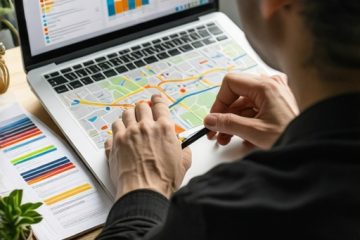
The smell of wet concrete always reminds me of a digital audit gone wrong. I spent years wandering through city grids with a camera in one hand and a smartphone in the other, noticing how the physical world often clashes with the data layers Google tries to impose on us. Every storefront is more than a door; it is a cluster of high-frequency pings in a spatial database. My perspective changed when I realized that a business listing is not a profile. It is a proximity beacon. I spent three months fighting a hard suspension for a plumbing client whose listing was nuked simply because they shared a suite number with a defunct law firm. Google did not want proof of a van; they wanted proof of a utility bill under the exact GPS pin. That battle taught me that the map algorithm does not care about your marketing budget. It cares about the forensic truth of your existence in a specific set of coordinates. To fix a suspended GMB profile, you have to stop thinking like a copywriter and start thinking like a private investigator. Scaling local growth requires understanding that the city is a grid of trust scores. If your data is messy, your beacon is dim.
The digital ghost inside the GPS coordinates
Winning the Google 3-Pack requires an obsession with GPS coordinate salience and centroid proximity. Google uses latitude and longitude to determine the relevance of a LocalBusiness entity. You must Update Google Business Profile data to match the real-world location signals provided by mobile device pings and Wi-Fi SSID triangulation. When you look through a lens at a storefront, you see brick and glass. The algorithm sees a mathematical point. This point is subject to the Opossum filter, which suppresses listings that are too close to each other in the same category. If you want to get featured in Google 3-Pack results, you must understand the centroid of your city. The centroid is not just the geographic center; it is the center of commercial activity for your specific industry. I have seen businesses move three blocks and lose half their lead volume because they crossed an invisible boundary in the proximity math. This is the map pack secret that many agencies ignore. They talk about keywords while the algorithm is calculating the walking speed of a user in a rainstorm. You need to ensure your coordinates are locked. Every photo you upload should carry the invisible weight of the neighborhood it represents.
“Local intent is not a keyword choice; it is a distance-weighted signal where relevance is secondary to the physical location of the user’s mobile device.” – Map Search Fundamental
Why the physical address has become a liability
Verifying your physical location is the most dangerous step in local search because Google now views every new address as a potential spam vector. To Verify Google My Business effectively, you must provide secondary evidence like business licenses, utility bills, and clear signage that matches your digital footprint. The days of renting a virtual office in a skyscraper are over. I have walked past those buildings; they are graveyards of suspended listings. Google Vision AI now scans photos for the grain of the wood and the reflection in the glass to ensure a business is real. If you want to optimize your Google Business listing, you must prove you occupy the space. I have seen legitimate contractors get wiped out because their business name on the mailbox was a sticker rather than a permanent sign. This is where a GMB audit checklist becomes your survival guide. You are not just filling out forms; you are building a case for your right to exist on the map. The physical address is a tether. If that tether is weak, your ranking will float away during the next algorithm update. Stop trying to trick the system with fake suites; start documenting the reality of your workshop.
The three mile radius that dictates your revenue
Your local visibility is governed by a strict proximity radius that shifts based on the density of your competitors and the search intent of the user. To improve Google Business rank, you must focus on hyperlocal signals that prove your dominance within a tight three mile circle around your verified pin. The data shows that for most service industries, your primary leads come from people within a ten minute drive. This is why the real factors that decide the 3-pack order are often hidden in the behavioral patterns of the neighborhood. Google tracks how many people request directions to your shop from specific intersections. If no one ever drives to your location from the north side of town, you will eventually stop appearing in searches from that area. You can combat this with Local business SEO checklist items like creating location-specific landing pages. Use your camera to capture the landmarks nearby. When you show the algorithm that you are part of the local fabric, the radius expands. Proximity is a living thing. It breathes with the traffic patterns and the time of day. If you are not visible when the lights go down, you are losing the evening rush.
Local Authority Reading List
- How to Win the Google 3-Pack
- The Truth About Fast GMB Ranking
- Managing Citations for Multiple Locations
- Building a Local SEO Growth Plan
Forensic signals of a legitimate local business
Google Business local SEO tips often focus on text, but the future of ranking is found in the metadata of your visual assets and customer interactions. Effective GMB photo optimization involves uploading high-resolution, non-stock images that include customer-generated content and GPS-tagged files to verify your service area. As a photographer, I see the artifacts in a fake image. So does Google. If you use a stock photo of a smiling person in a hard hat, you are telling the algorithm you are a ghost. You need to use geo-tagged photos to prove your team is actually on the ground. Take a picture of your truck in front of a local monument. Capture the grain of the pavement in your parking lot. This forensic evidence is worth more than a thousand keywords. Most businesses fail because their photos are stale. To optimize your business profile photos, you must show the work being done in real-time. This triggers the ‘Justification’ feature in search results, where Google shows a snippet saying ‘Their website mentions…’ or ‘A reviewer said…’ alongside your listing. These are the signals that turn a browser into a buyer.
“Proximity is the strongest ranking factor in the local algorithm, often overriding traditional authority signals like backlink profile or domain age.” – Vicinity Update Analysis
The behavioral triggers that bypass traditional search
Scaling your growth requires moving beyond static optimization and focusing on user engagement metrics like click-through rate and click-to-call frequency. Local SEO optimization is now a measure of how many people interact with your profile after finding it in the mobile search results. When I watch people use their phones on the street, they don’t read descriptions; they look at the star rating and the distance. If your profile has a 4.8 rating but is two miles further away than a 4.2 rating, you might still lose. However, if your profile shows recent activity, like a post from two hours ago, you signal life. This is why you must pick a local SEO service that understands behavioral loops. Every time someone clicks ‘Call’ or ‘Directions,’ your trust score in that specific GPS sector increases. It is a feedback loop. The more people engage, the higher you rank, which leads to more engagement. You need fastest ways to rank that focus on these real-world actions. Stop worrying about meta descriptions on your site and start worrying about why no one is clicking your ‘Request a Quote’ button on the map. The map is an interactive dispatch system, not a phone book.
The invisible links that bind a neighborhood
Citations are the digital backbone of your local authority, but their value has shifted from quantity to the quality and consistency of your Name, Address, and Phone number. Utilizing GMB citation services should focus on cleaning up legacy errors and ensuring your data is identical across the major data aggregators. I have seen businesses with five hundred citations that could not rank because their address was listed as ‘Street’ in half and ‘St.’ in the other. This lack of NAP consistency creates a fracture in the algorithm’s trust. It thinks you might be two different businesses. You need a no-nonsense guide to citations to understand that the local chamber of commerce link is worth more than fifty generic directory spots. The algorithm looks for local relevance. A link from the neighborhood blog carries more weight for a plumber than a link from a national trade magazine. It is about the digital footprint of the neighborhood. If you want to scale, you must be a local celebrity in the eyes of the data aggregators. Clean up your duplicates. Fix your phone numbers. Every inconsistent digit is a leak in your revenue pipe. The city is watching, and the city does not like mistakes.
About the Author
Mohamed Sabry
Optima Cleaners
Mohamed Sabry is a dedicated digital marketing specialist and local SEO expert with a strong academic foundation from The American University in Cairo. With a background that includes strategic roles at Optima Cleaners, Mohamed has developed a deep understanding of what it takes to make local service businesses stand out in a competitive digital landscape. His expertise lies in optimizing Google Business Profiles and implementing advanced SEO strategies that drive tangible growth and visibility for brands. At rankingseogmb.com, Mohamed leverages his analytical skills and practical experience to provide readers with actionable insights into search engine algorithms and local ranking factors. He is known for his meticulous approach to data and his ability to translate complex technical concepts into clear, effective strategies for business owners. Having earned top academic honors during his studies, Mohamed brings a high level of professionalism and excellence to every project he undertakes. He remains committed to staying at the forefront of the ever-evolving SEO industry to ensure his audience receives the most current and effective advice. Mohamed is deeply passionate about empowering small business owners and entrepreneurs to achieve their full potential through digital excellence.