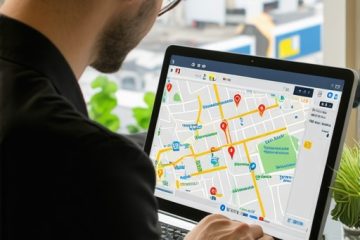
The hidden physics of the local map pack
I spent three months fighting a hard suspension for a plumbing client whose listing was nuked simply because they shared a suite number with a defunct law firm. Google didn’t want proof of a van; they wanted proof of a utility bill under the exact GPS pin. This is the reality of the hyper-local layer. It is a world where a national franchise with a million-dollar budget can lose to a solo contractor who understands the microscopic math of the centroid. Small businesses often feel outmatched by corporate giants, but the local algorithm is not a popularity contest. It is a proximity and relevance engine that rewards the physical truth of a business location over the abstract strength of a brand name. To win, you must stop thinking like a digital marketer and start thinking like a logistics manager who understands how spatial data actually functions.
The invisible boundary of the three mile radius
Proximity signals, user location data, and local search intent dictate who appears in the Google 3-Pack. Unlike traditional organic search, Google Maps SEO depends on the physical distance between the searcher and the verified GMB listings. A big brand five miles away will often lose to a small shop two blocks away. This distance-weighted signal is the primary lever that small businesses can use to reclaim their territory. The algorithm treats the user’s mobile device as the center of the universe. When a search occurs, the engine scans for the nearest verified Google My Business profile that demonstrates high NAP citation consistency and recent behavioral activity. If you are a small business owner, your goal is to become the most relevant beacon within a tight geographic polygon. You do not need to rank for the whole city; you only need to dominate the three-mile radius surrounding your front door. This is where the map pack secret reveals itself. Big brands struggle with this because their data is often managed by centralized agencies that lack the granular knowledge of local street names or neighborhood nicknames that trigger the proximity algorithm.
Why your physical address is a liability
Business location signals, commercial zoning verification, and GPS coordinate salience are the factors that determine if your GMB SEO audit passes the trust threshold. Many small businesses make the mistake of using residential addresses or coworking spaces, which are red flags for the spam team. Google views an address as a trust anchor. If your NAP consistency is off by even a single character in your suite number, you risk being filtered out of the map results. I have seen businesses vanish because they updated their phone number on a secondary directory but forgot to change it on their own footer. This lack of NAP consistency creates a conflict in the database. The algorithm sees two different versions of the truth and decides to show neither. To beat the big brands, you must be a perfectionist with your data. Ensure your physical location is documented with a legal lease and utility bills that match your digital footprint exactly. This forensic level of detail is often overlooked by national chains that have hundreds of locations to manage, giving the local merchant a distinct advantage in the eyes of the verification bots.
“Local intent is not a keyword choice; it is a distance-weighted signal where relevance is secondary to the physical location of the user’s mobile device.” – Map Search Fundamental
Local Authority Reading List
- Understanding Local SEO for Small Businesses
- How to Fix a Suspended GMB Profile
- The Factors Deciding the Google 3-Pack Order
- Winning the 3-Pack in Saturated Markets
- The Truth About Maps Ranking Factors
The forensic evidence within your business photos
Image metadata, geotagged photos, and user-generated content provide a depth of local proof that big brands cannot easily replicate. While a corporation might use polished stock photos, a local business can upload a raw, timestamped image of a truck parked on a specific local street. Google’s AI analyzes these photos to extract EXIF data and recognize local landmarks. This creates a massive boost in Google Maps presence. When a customer takes a photo at your location and uploads it with their review, they are providing an irrefutable proof of service. I often tell my clients that a grainy photo of a completed job site taken by a customer is worth ten professional studio shots. This is how you improve Google Business rank through behavioral signals. Big brands cannot automate the authenticity of a local community. By encouraging real customers to document their experience, you are feeding the local map pack SEO engine the very thing it craves most, which is ground-truth verification that your business actually exists and serves people in the neighborhood.
Why big brands fail at local justification
Local justifications, review sentiment analysis, and service area polygons are the mechanisms that allow a small business to jump ahead of a global franchise. Have you ever noticed a small snippet of text under a map listing that says “Sold here” or “Provides service to”? These are justifications. They are triggered by the specific language used in your reviews and on your website. Big brands use generic descriptions. Small businesses can use GMB keyword research to find the exact terms their neighbors use. If you want to improve Google Maps presence, you need to speak the language of the local street. This means mentioning specific landmarks, neighborhood names, and niche services that a national chain would ignore. The algorithm reads your reviews and looks for these keywords to justify why you should be in the top three. It is a mathematical weight of sentiment. A big brand might have a higher overall review count, but if your reviews are more geographically relevant and mention the specific service the user is searching for, you will win the spot.
“Consistency is the heartbeat of local search; a single mismatched digit in a phone number is a signal of unreliability that the algorithm will punish with invisibility.” – The Local Search Handbook
The secret power of service area polygons
Service area business (SAB) settings, verified service regions, and radius-based visibility allow contractors and mobile businesses to compete without a traditional storefront. Many owners struggle with service area radius settings because they try to cover too much ground. Google rewards specificity. If you claim to serve a 100-mile radius but only have three reviews from one small town, the algorithm sees a mismatch. The key to Google Maps SEO strategies for service businesses is to define your polygon based on where you actually have a physical presence and customer history. This is where you can use local service areas to expand your reach strategically. Instead of a broad circle, create a custom map that follows the actual roads your vans travel. This data tells Google that you are an authority in those specific zones. Big brands often use a single office to cover a whole state, which makes their data weak and generalized. Your localized data, verified by real customer check-ins and job site photos, creates a much stronger proximity beacon.
The forensic trace of a verified listing
Advanced GMB verification, video audits, and postal code validation represent the final hurdle in the battle for local dominance. The Google Business SEO checklist is not just about filling out a profile; it is about surviving the constant vetting of a suspicious algorithm. Many listings are disabled because the owner cannot provide a live video walk-through of their location. This is where the “reinstatement war” is won or lost. If you are a small business owner, you must have your documentation ready. Keep your business license, lease, and utility bills in a digital folder. Use the best tools for GMB SEO to track your rankings across different GPS coordinates. This allows you to see exactly where your visibility drops off. Big brands often lose their listings to “map spam” reporting because their profiles are managed by interns who do not understand the TOS. By maintaining a clean, verified, and active profile, you build a moat of trust that is very difficult for a distant corporation to cross. This is the ultimate way to improve Google Business rank and ensure your phone keeps ringing.
About the Author
Mohamed Sabry
Optima Cleaners
Mohamed Sabry is a dedicated digital marketing specialist and local SEO expert with a strong academic foundation from The American University in Cairo. With a background that includes strategic roles at Optima Cleaners, Mohamed has developed a deep understanding of what it takes to make local service businesses stand out in a competitive digital landscape. His expertise lies in optimizing Google Business Profiles and implementing advanced SEO strategies that drive tangible growth and visibility for brands. At rankingseogmb.com, Mohamed leverages his analytical skills and practical experience to provide readers with actionable insights into search engine algorithms and local ranking factors. He is known for his meticulous approach to data and his ability to translate complex technical concepts into clear, effective strategies for business owners. Having earned top academic honors during his studies, Mohamed brings a high level of professionalism and excellence to every project he undertakes. He remains committed to staying at the forefront of the ever-evolving SEO industry to ensure his audience receives the most current and effective advice. Mohamed is deeply passionate about empowering small business owners and entrepreneurs to achieve their full potential through digital excellence.