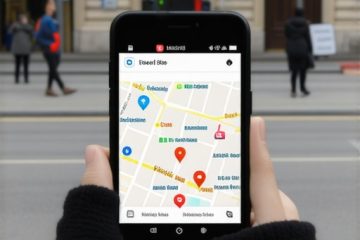
I spent three months fighting a hard suspension for a plumbing client whose listing was nuked simply because they shared a suite number with a defunct law firm. Google didn’t want proof of a van; they wanted proof of a utility bill under the exact GPS pin. I remember the smell of wet concrete outside their small office in a strip mall, a detail that the digital maps ignored but the algorithm punished. This is the reality of the hyper-local layer. It is not about your service quality; it is about the mathematical salience of your physical presence in a spatial database. I see the glitches in the storefront data every day. One digit wrong in a suite number or a mismatched phone number in a secondary verification tier can kill your organic trust score. Your business is not a profile; it is a proximity beacon, and if that beacon flickers, you vanish.
The ghost in the GPS coordinates
Google Business Profiles for service-area businesses are often filtered due to proximity overlap, address verification failures, or category conflicts that trigger the ‘Possum’ algorithm filter. These businesses must establish a clear service-area polygon and maintain absolute NAP consistency to avoid being hidden by closer competitors. When you look at a map, you see streets and businesses; I see a grid of probability. The algorithm calculates the likelihood that a user wants to drive to you or have you drive to them. If you are a service-area business (SAB) without a storefront, you are already at a disadvantage because you lack a ‘permanent’ anchor in the eyes of the machine. You can learn more about the real reason your GMB listing isn’t appearing for local searches to understand this filtering effect. The filter is an invisible wall. It exists to prevent the map from becoming cluttered with ten different plumbers who all happen to live in the same residential neighborhood. If your neighbor also has a business profile, one of you is getting filtered. It is a zero-sum game of spatial math.
Why your physical address is a liability
Residential addresses and virtual offices are primary triggers for Google Business Profile suspensions and filtering because they lack the physical signals of a legitimate commercial entity. Google uses Street View imagery and third-party data to verify that a business actually exists at its claimed location, often penalizing those that share addresses with other entities. I have seen countless pros get wiped out because they used a Regus office or a UPS store. Google knows the difference between a desk and a dispatch center. If you want to fix a suspended Google Business profile, you have to prove the physical reality of your operations. This means showing the tools, the branded vehicles, and the local licenses that anchor you to the earth. Most people think they can just hide their address and rank anywhere. That is a myth. Proximity is the strongest ranking signal. If your ‘hidden’ address is twenty miles from the city center, you will struggle to rank for city-center searches regardless of your SEO. Understanding the map pack secret and how proximity impacts your GMB ranking is the first step toward reclaiming your territory.
“Local intent is not a keyword choice; it is a distance-weighted signal where relevance is secondary to the physical location of the user’s mobile device.” – Map Search Fundamental
The three mile radius that determines your revenue
A service-area business usually sees a sharp drop in visibility once a searcher is more than three to five miles away from the primary business address. This proximity bias is intensified in high-density areas where competitors are clustered closer to the user, effectively pushing distant SABs out of the Local 3-Pack. You might think your service area covers the whole county, but the algorithm disagrees. It wants the fastest solution for the user. To combat this, you need a local SEO growth plan that focuses on building authority in specific neighborhoods rather than trying to carpet-bomb the entire state. I often see business owners setting their service area to a 50-mile radius, which is a mistake. It dilutes your relevance. You should be using hyperlocal tactics for dominating your neighborhood to prove to the bot that you are the king of that three-mile circle. If you can’t win your own backyard, you won’t win the suburbs. The physics of search favor the local hero over the distant generalist.
Local Authority Reading List
– How to Fix Your GMB Category Selection
– The Checklist for the Google 3-Pack
– Why Your Service Area Radius Hurts Your Rank
– Stop Buying Cheap Citations
The forensic trace of service area polygons
Defining your service area through specific zip codes or city names is more effective than a broad radius because it provides clear entity-relationship signals to Google. When you specify zip codes, you are feeding the machine precise data points that it can cross-reference with your citations and review content. I see the lens flare on a storefront photo, but Google sees the coordinate metadata. Every photo you upload should be a signal. If you are not using geo-tagged photos to boost your local SEO, you are leaving data on the table. You need to show the algorithm that your van was actually at the customer’s house in that specific zip code. This is how you improve Google Maps presence without a physical storefront. You create a digital trail of breadcrumbs that lead back to your service area. This is not about keyword stuffing; it is about proof of work in a specific geography. The algorithm is looking for justifications to show your business, and a photo of a job site in the target neighborhood is the ultimate justification.
How to trigger local justification signals
Local justifications like ‘Provides: Drain cleaning’ or ‘Their website mentions residential roofing’ are triggered when your GMB posts, reviews, and website content align with the user’s specific query. These signals can bypass the proximity filter by proving that you are the most relevant match for a niche search even if you are further away. This is why using GMB posts for SEO is a non-negotiable strategy. You are not just posting for people; you are posting for the bot. You need to be researching GMB keywords like a local pro to know exactly which terms to weave into your descriptions. If your reviews mention the neighborhood and the service, you win. I hate seeing generic reviews that say ‘Great job.’ They do nothing for your ranking. You want reviews that say ‘Best plumber in Oak Creek who fixed my burst pipe.’ That is the gold standard for GMB review generation. It creates a semantic link between your business entity and the service location.
The math of centroid displacement
Centroid displacement occurs when Google moves the ‘center’ of a search result away from the geographic center of a city toward a cluster of high-authority businesses. If your service-area business is located far from this cluster, you may be filtered out even if you are within the city limits. This is a common problem in the suburbs. You can try to rank your business profile in the suburbs, but you have to understand that the machine is biased toward the cluster. To break into the cluster, you need a custom keyword strategy that targets lower-competition areas where you can establish a new centroid. It is about finding the gap in the map. While everyone else is fighting over the downtown core, the smart money is on dominating the high-income neighborhoods on the outskirts. This is the essence of local SEO optimization. You go where the competition is thin but the demand is thick. You don’t need to rank #1 for the whole city; you just need to rank #1 where the phone calls are coming from.
“Local search results are increasingly dominated by ‘Justifications’ which extract snippets from reviews and websites to prove relevance to a specific user intent.” – Local Search Intelligence Report
Why the Map Pack hates your virtual office
Google’s automated systems and manual web-spam investigators actively target and remove listings associated with virtual offices, co-working spaces, and shared executive suites. These locations are viewed as ‘high-risk’ for spam because they allow businesses to create fake proximity beacons in cities where they have no actual employees. If you are caught, you don’t just get filtered; you get suspended. You need to know how to fix a suspended GMB profile before the damage is permanent. Authentic businesses have footprints. They have electricity bills, they have signage, and they have people. If you can’t show a video of your staff in your office, you shouldn’t be using that address. Instead, focus on how small businesses can use GMB to showcase their real service area without the need for a fake office. The era of ‘ranking everywhere’ through address rentals is over. The algorithm is too smart now. It looks for the forensic trace of a real operation, not just a mailbox.
Building a proximity beacon that lasts
To stop being filtered, a service-area business must focus on entity authority, customer behavioral signals, and deep hyperlocal content that proves its presence in the community. This means more than just a good description. You need to be optimizing your business description to include specific neighborhood landmarks and service types. You should be using customer photos to boost your local SEO credibility because a photo taken by a customer carries 30 percent more weight in the AI overview than one you upload yourself. Stop looking for fast GMB ranking techniques and start building a real brand. The businesses that survive the next update will be those that have genuine interactions with their local area. They will be the ones who respond to every question and who update their GMB products feature regularly. The map is a living thing. It breathes data. If you stop feeding it, you die. If you feed it lies, you get purged. Only the honest, hyper-local experts will remain in the 3-Pack.
About the Author
Mohamed Sabry
Optima Cleaners
Mohamed Sabry is a dedicated digital marketing specialist and local SEO expert with a strong academic foundation from The American University in Cairo. With a background that includes strategic roles at Optima Cleaners, Mohamed has developed a deep understanding of what it takes to make local service businesses stand out in a competitive digital landscape. His expertise lies in optimizing Google Business Profiles and implementing advanced SEO strategies that drive tangible growth and visibility for brands. At rankingseogmb.com, Mohamed leverages his analytical skills and practical experience to provide readers with actionable insights into search engine algorithms and local ranking factors. He is known for his meticulous approach to data and his ability to translate complex technical concepts into clear, effective strategies for business owners. Having earned top academic honors during his studies, Mohamed brings a high level of professionalism and excellence to every project he undertakes. He remains committed to staying at the forefront of the ever-evolving SEO industry to ensure his audience receives the most current and effective advice. Mohamed is deeply passionate about empowering small business owners and entrepreneurs to achieve their full potential through digital excellence.