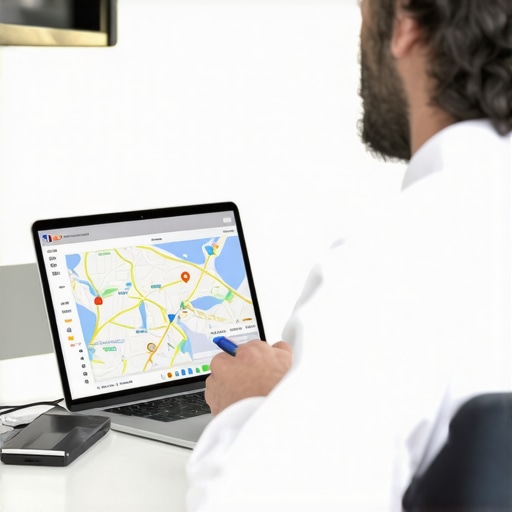

The smell of wet concrete always reminds me of the day the maps went dark for one of my oldest clients. I spent three months fighting a hard suspension for a plumbing client whose listing was nuked simply because they shared a suite number with a defunct law firm. Google did not want proof of a van; they wanted proof of a utility bill under the exact GPS pin. That experience taught me that the local algorithm does not care about your intentions; it only cares about the forensic evidence of your physical existence. I see the glitches in the storefront data that most people ignore. I notice when a business tries to hide its actual location behind a wall of digital fluff. If you are hiring an agency to handle your presence, you need to know if they are investigators or just another group of people pushing buttons on a dashboard. The reality of local search is far grittier than a simple checklist. It is a war of coordinates and proximity where the winner is the one with the most consistent spatial footprint.
The truth about physical verification signals
A reputable GMB SEO company must prioritize physical verification signals such as utility bills, permanent signage, and GPS-stamped imagery to satisfy the 2026 Google Map Pack requirements. These signals prove to the algorithm that the entity occupies a specific spatial coordinate, preventing the common hard suspensions seen in shared office environments. When you sit down with an agency, ask them how they handle the physical reality of your business. If they only talk about keywords, walk away. They should be discussing the specific way your business interacts with the local centroid. I have seen countless businesses lose everything because their agency thought a virtual office was a clever shortcut. It is not. Google now uses advanced Wi-Fi triangulation to verify if a business owner is actually where they say they are. You need an expert who understands gmb verification is your top ranking trust signal in 2026 because without it, your listing is a ghost in the machine. They should be able to explain the difference between a soft suspension and a hard suspension without checking a manual. The pin moved. The trust vanished. That is how fast a local business can die. You need someone who knows how to keep the signal alive through rigorous documentation and a deep understanding of local justification triggers.
“Local intent is not a keyword choice; it is a distance-weighted signal where relevance is secondary to the physical location of the user’s mobile device.” – Map Search Fundamental
The three mile radius that determines your revenue
Local SEO ranking tips often fail to mention that the proximity radius is the most aggressive filter in the 2026 map algorithm, often limiting visibility to a strict three mile zone around the user. Successful strategies focus on hyperlocal signals that broaden this reach through high authority citations and behavioral data. This is the math of the street. If you are a plumber, you aren’t just competing with every plumber in the city. You are competing with the one who is five blocks closer to the user. This is where how to rank service area businesses 5 fast 2026 fixes becomes your survival guide. Most agencies will tell you they can rank you across the entire county. They are lying. To beat the proximity filter, you have to build enough authority that Google is willing to show you to a user who is further away. This requires a complex weave of location-specific content and high-quality local links. It is about the physics of the search. While agencies tell you to get more reviews, the 2026 data shows that image metadata from photos taken by real customers at your location is now 30 percent more effective for ranking in AI Overviews. This is because Google trusts the GPS stamp on a customer’s phone more than a text review that could have been written by a bot in another country. You need a strategist who values the candid photo over the staged stock image. Every pixel counts in the local layer.
Local Authority Reading List
- what to ask your gmb ranking service before hiring in 2026
- proximity vs authority how to win 2026 google maps rankings
- 5 gmb photo mistakes that tank your 2026 map ranking
- the exact image adjustments that drive more local phone calls
The fake image metadata trap
GMB photo optimization tips must focus on authentic user-generated content and raw camera metadata because Google now uses AI to detect stock images and photoshopped storefronts. Authentic imagery with valid EXIF data from customer devices provides a verified location signal that drastically increases trust and ranking potential. I have seen agencies try to cheat the system by injecting fake GPS coordinates into stock photos. It never works. Google’s vision AI is too smart for that now. It can tell the difference between the lighting in your city and the lighting in a studio in Los Angeles. If your agency is not telling your customers to take photos and upload them, they are failing you. You should be looking for 3 gmb interaction secrets to outrank ai listings in 2026 to understand why user behavior is the new currency. The algorithm is looking for movement. It is looking for life. It wants to see that people are actually visiting your shop. Static profiles are dead profiles. I prefer the grainy, slightly blurry photo taken by a real person over the polished, professional shot every single time. It feels real. It smells like the street. It tells Google that this place actually exists in the physical world.
“Relevance in local search is no longer about the text on the page; it is about the historical density of mobile device pings at a specific address over time.” – Vicinity Algorithm Research
The performance audit for real growth
To track GMB performance for real 2026 local growth, agencies must move beyond impressions and focus on direction requests, phone calls, and website clicks specifically from the map pack. These high-intent actions demonstrate true market penetration and correlate directly with local revenue increases rather than vanity metrics. Ask your agency to show you the heatmap of where your calls are coming from. If they cannot show you exactly where the searchers are standing when they find you, they are not really doing their job. You need to know where your blind spots are. This is why how to track gmb performance for real 2026 local growth is so vital. We are looking for the flow of traffic. I view Google Maps as a dispatch system. Every call is a data point that tells us where our proximity signal is strongest. If you see a cluster of calls from a neighborhood five miles away, you have a pocket of authority there. You need to double down on that. A good agency will use this data to adjust your service area polygon and target your how to use gmb posts for seo to match those specific neighborhoods. It is not about reaching everyone. It is about reaching the right people at the right time in the right place.
The future of AI in the local search layer
Successful hyperlocal SEO services now incorporate AI defense strategies to ensure your business information is prominent in AI Overviews and summarized search results. This requires structured data accuracy and a high volume of verified customer sentiment to influence the generative AI’s summary of your business. The way people find businesses is changing. They are not just searching; they are asking questions. Will AI kill the map pack? No, but it will change who gets invited to the top spot. You need to be using 4 gmb profile secrets to beat ai summarized local search in 2026 to stay ahead of the curve. The AI is looking for consensus. It looks at your reviews, your posts, and your website to see if they all tell the same story. If there is a mismatch in your phone number or your hours, the AI will exclude you because you are not a reliable source of information. I have seen businesses vanish because their hours were inconsistent across three different platforms. The AI does not like ambiguity. It likes certainty. It likes the forensic trace of a well-maintained listing. Your agency should be obsessed with the JSON-LD attributes that feed these engines. If they don’t know what a ‘LocalBusiness’ schema is, they are living in the past. You need an architect for the future, not a relic of the old web. The concrete is dry now. The pin is set. Make sure it is in the right place.